
Preparing your Pinterest Ads campaigns for the fourth quarter
A dated Pinterest Ads calendar for Q4: when to launch, which budgets, when offers move to retargeting, and how to keep going through the January sales.
 Luc Bermond
This tutorial is for brands that already run an active Pinterest Ads account and want to know what to launch, when, and with which settings between late September and the January sales. It follows the chronological order we apply on the accounts we manage, with the observations shared on video over five year-end seasons. By the end, you will have a dated calendar, a campaign structure to build in October and the budget rules to hold in November.
Before you start
- An active Pinterest Ads account, with the tag installed and the "Checkout" event firing (see install the Pinterest tag on Shopify).
- A synced product catalog, even if the shopping campaign comes later.
- A filled-in Pinterest profile: we recommend 5 to 10 boards of 15 to 20 pins before spending the first euro.
- The dates of your operations (Black Friday, Cyber Monday, last shipping date before Christmas, sales) already set.
Why this step matters
On Pinterest, the fourth quarter is not decided in November. People looking for a gift idea start in September and save pins for weeks before they buy. We explain it in the video below, recorded in October 2025: on Pinterest Trends, the keyword "gift idea" ("idée cadeau" on the French Trends) climbs sharply from the first week of November and peaks on December 6. A campaign that starts mid-November arrives after the rise, not before.
 Winning Q4 in e-commerce with Pinterest Ads (October 2025)
The second reason is the algorithm. On the accounts we manage, a campaign's learning phase lasts 7 to 10 days, up to 14 on some accounts. We have been repeating it since 2022: an advertiser who launches mid-November has a warm algorithm around November 25, too late to raise budgets for Black Friday week. That is why this tutorial's calendar exists: warm up the account in October so it is ready by mid-November.
The third reason is the cost of delivery. Our October 2025 video records, on an account we manage, a CPM of about €1.30 the week of November 20, 2024, €1.60 the following week and €1.68 on Black Friday itself, even though budgets had been raised. In November 2024, we placed Black Friday CPMs between €1.50 and €2; in October 2022, between €2.50 and €3. Over the same period, the Meta CPMs we cite come close to €15 (LinkedIn post, fall 2025). These are dated readings, not a promise: advertising competition rises little on Pinterest at year end, which is what makes anticipating worthwhile.
One last observation, and it shapes every step: acquisition creative must inspire, and the offer is reserved for retargeting. The observation is constant: an account that pushes promo codes to people who do not know it yet sees its CPMs climb. Q4 reads in two phases: inspire in October and early November, convert with an offer from Black Friday week onward.
Late September: check the foundations before spending
Open Ads Manager and check three things: the "Checkout" event is showing under Conversions, the catalog is synced without a blocking error, and the Business profile is complete (logo, description, link to the site, banner, boards).
The profile is not a detail. We say it again in the September 2026 video: a user who sees your promoted pin can click through to the site or open your profile. A profile with one board and a pin that is eight months old loses part of the paid traffic.
Early October: read the search calendar in Pinterest Trends
Open Pinterest Trends, set the region to France and type your product keywords, then "gift idea" followed by your category. Compare two or three phrasings to spot the one with the most volume.
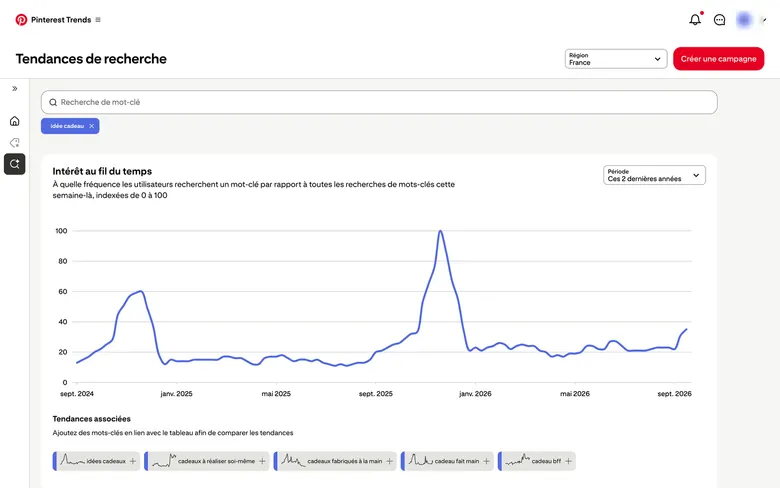
“idée cadeau” over two years, France region: the curve takes off in mid-October, climbs sharply in November and peaks during Black Friday week, then falls back before Christmas. The calendar repeats from one year to the next. - Set the region to “France” before reading anything
- Period “last 2 years” to compare two seasons
- The take-off: mid-October, sharp rise in November
- The peak: Black Friday week, then back to baseline before Christmas
We use the tool in two ways: by positioning ourselves at the end of November of the previous year to see what was rising then, and by looking at the start date of each curve. In our November 2024 video, "Christmas table decor" starts on October 11 and peaks on December 21. In our August 2026 video on Pinterest SEO, Christmas-related searches start as early as September, with a sharp rise from October.
 The last quarter's search calendar on Pinterest (August 2026)
For each keyword family, note the start week and the peak week: that calendar sets the launch date of your keyword campaigns, ahead of the rise.
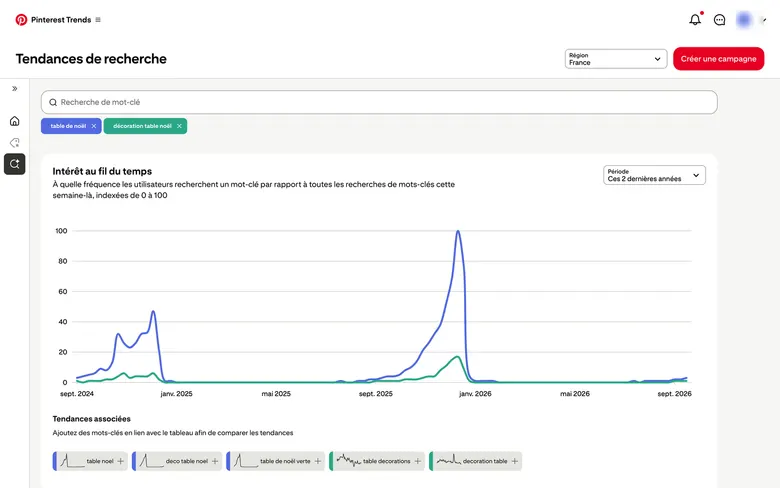
Two phrasings of the same need: “table de noël” (blue) carries the volume, “décoration table noël” (green) stays marginal. Both start in early October and peak in early December, then drop from mid-December. - Each added keyword becomes a coloured chip and the curves overlay
- The start: early October, ahead of “idée cadeau”
- The peak: early December, then a drop from mid-December
First half of October: launch acquisition on small budgets
Create your first campaigns with the Conversions objective and the Checkout event. Not "Traffic", not "Awareness": as we explain in the September 2026 video, unlike Meta, the conversion objective is not more expensive to deliver on Pinterest.
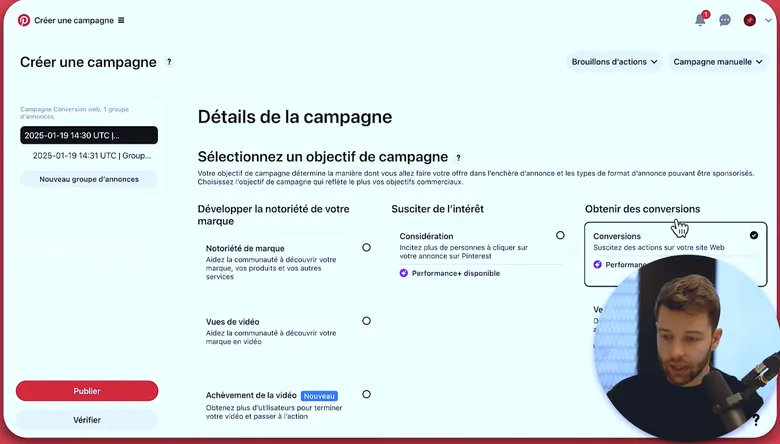
Conversions from the very first October campaign. Neither Traffic nor Awareness: on Pinterest, the conversion objective costs no more to deliver. - Conversions, selected
- Awareness: left aside
 The campaign structure to prepare for the last quarter (September 2026)
Keep targeting separate: one campaign per keyword group, one campaign per interest. If you mix both in the same ad group, the spend goes to the interests and the keywords do not deliver. For interests, we aim for an audience above 1 million in France; for keywords, above 100,000. Stay on top-level interests in October.
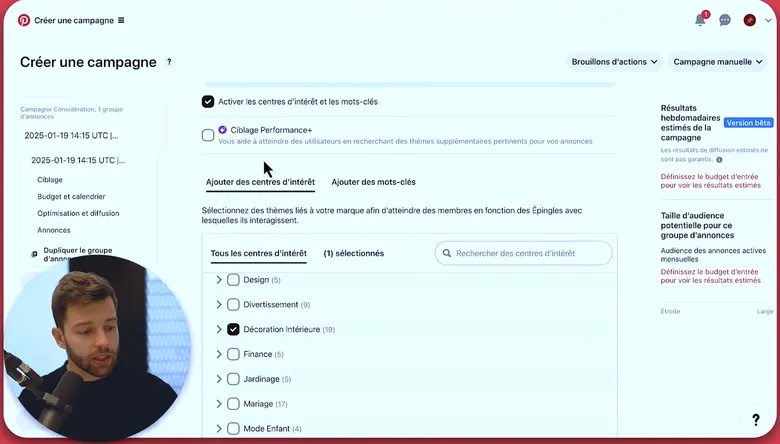
One campaign per top-level interest. Keywords get their own campaign: mixed together, the budget goes to interests. - A single top-level interest, ticked on its own
- Keywords: another tab, another campaign
On budget, start low: the usual benchmark is €5 to €20 per day per campaign at launch. With a CPM around €1, that is enough to reach several thousand people a day and let the algorithm learn.
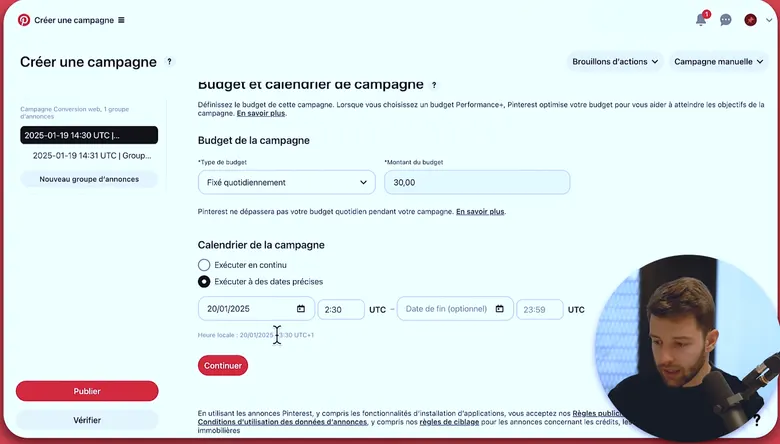
Fixed daily budget, no end date, start scheduled for the next day early in the night. The amount sits between €5 and €20 per campaign at launch. - Fixed daily budget
- End date left empty: the campaign runs continuously
October: inspirational creative and open landing pages
For acquisition, produce pins that show the product in use, with no offer and no promo code. Before producing anything, type "gift idea" followed by your sector into Pinterest search and look at which formats stand out. On the accounts we manage, home decor and fashion work mostly in static, collection or carousel; beauty and products that need a demonstration do better in video.
For the destination, test collection pages or a multi-product "gift ideas" page rather than the product page alone: on our accounts, it often takes several touchpoints before the purchase. The product page remains the destination for retargeting and shopping.
Mid-October to early November: add shopping and dynamic retargeting
If your catalog has more than about thirty products and the account is approved as a Verified Merchant, create a shopping campaign (objective Catalog sales) optimized for conversions. The pin shows price and availability and sends people to the product page. In our view, these are the campaigns best suited to the year-end season.
Then create a dynamic retargeting campaign on the catalog: someone who viewed a product sees that same product again. This is the campaign that will carry the offers from Black Friday week onward. If you use a feed management tool, optimize catalog titles and visuals now: on our accounts, the difference shows mostly in retargeting.
Finally, test a Performance+ campaign alongside the manual campaigns, not instead of them. We explain it in the November 2024 video: Performance+ works better on an account that is already warm, and an account that only has automated campaigns levels its results downward. The tutorial Performance+: when to enable it details the conditions.
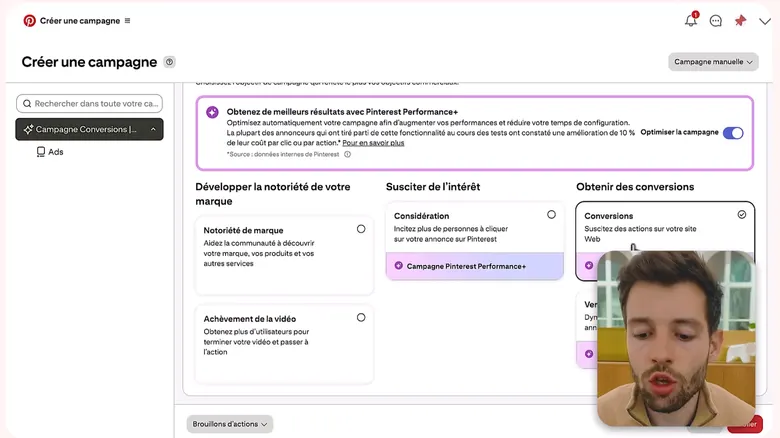
The switch that turns a campaign into Performance+. To test in November alongside the manual campaigns, not instead of them. - The “Optimize the campaign” switch: Performance+ on
Mid-November: the account is warm, time to scale
Around November 15, take stock: which campaigns have held their target for more than ten days, which creatives stand out, which targeting costs too much. That is what we call a "warm account", and only from that point do we increase.
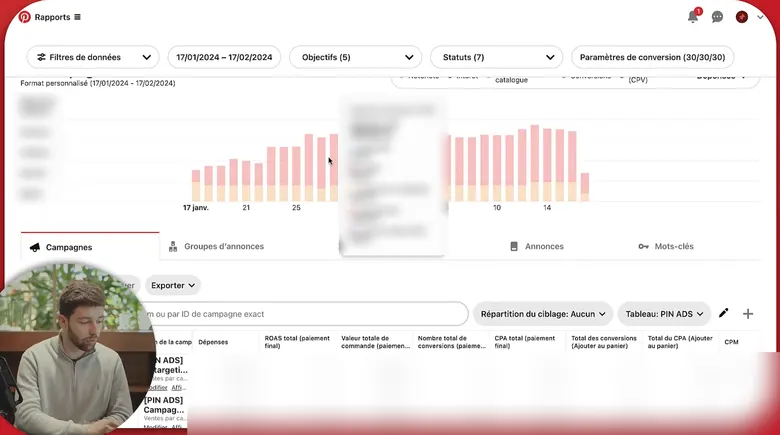
What a warm account looks like: 32 active campaigns, one per targeting, modest budgets that add up. Amounts are masked. - A steady daily spend, split by objective
- The Campaigns tab: 32 active rows
On Pinterest, increases happen horizontally first. Rather than doubling the budget of a campaign that works, duplicate it and change one variable: keywords, interest, creative, landing page, product group for shopping. Doubling or tripling a budget, as you would on Meta, sends the campaign back into learning. Our accounts end the season with around twenty active campaigns, most of them on modest budgets.
For vertical scaling, the rule is: under about ten euros a day, a 50% increase goes through; from €50 to €100 a day, no more than 20 to 30% at a time.
Black Friday week: the offer goes to retargeting, not acquisition
Turn on your offer campaigns on the retargeting audiences: site visitors, add-to-carts that did not convert, people who engaged with your pins. The creative changes register: static, short message, promo code or free shipping clearly readable, social proof if you have it. This is where the Black Friday peak happens on the accounts we manage, because the audiences were built in October.
Keep the acquisition campaigns running with their inspirational creative. Do not swap their visuals for the offer: that is the typical case where the CPM climbs. Bring the site in line (homepage banner, "gift ideas" page, current offer): the site has to follow the operations calendar, from Black Friday to Christmas.
December: switch to Christmas mode and hold on past the shipping deadline
From the start of the month, move the acquisition creative to the Christmas universe and the keywords "Christmas gift", "gift box", "Christmas gift idea for her" or "for him", following the curves noted in October.
 Year-end strategy: Black Friday, Christmas and after (November 2024)
Do not cut the campaigns at the shipping deadline. We explain it in the November 2024 video: many advertisers leave Pinterest at that point and, on our accounts, the period from December 20 to early January has worked very well with a "last-minute gift" angle, in pure acquisition. Gift cards, fast shipping or in-store pickup are the angles to push during those ten days, depending on what your logistics allow.
January: switch to the sales without starting from scratch
Keep the always-on campaigns that hold their target: some campaigns have been running for more than twelve months on our accounts, and we have been saying since 2022 that the hardest part on Pinterest is the start-up phase. Cutting a campaign that works in January means paying for that learning again.
Change the creative and the offers, not the structure. In a January 2026 LinkedIn post, we note from Pinterest's winter sales report that checkouts rise week after week in January, and that searches shift toward storage, self-care and Valentine's Day. Add keyword campaigns on those themes rather than editing December's.
 Our 2022 Q4 strategy: what has not changed since


What you should see
- Acquisition campaigns that finished their learning phase before November 1.
- A readable structure by mid-November: keywords, interests, shopping, dynamic retargeting, one Performance+ test alongside the manual campaigns.
- CPMs close to October's during Black Friday week, with budgets up.
- Offer campaigns that only run on retargeting audiences.
- Campaigns still active between December 20 and the sales, with adapted creative.
What usually goes wrong
- The account starts mid-November. The mistake we cite in every one of our year-end videos since 2022: the algorithm becomes usable around November 25, too late to scale before Black Friday.
- Meta creative is recycled as is. Big offer, promo code from the first impression. On our accounts, those campaigns see their CPMs climb and their return on ad spend divided by two or three compared with creative designed for Pinterest.
- Keywords and interests sit in the same ad group. The spend goes to the interests, and the advertiser concludes that "keywords don't work".
- The budget is doubled on Black Friday. The campaign goes back into learning at the worst moment. The increase is prepared a week ahead, by duplication and in steps.
- Everything runs on Performance+. On a cold account, the automated campaign lacks signals; on a warm account, it plateaus when it is alone.
- Campaigns are cut at the shipping deadline. Most advertisers abandon the December 20 to early January window, yet we have seen some of our best acquisition campaigns there.
I am reading this tutorial in mid-November: is it too late?
No, but you will not benefit from Black Friday week. Launch the conversion campaigns on small budgets anyway and aim for Christmas, then the ten days after the shipping deadline. You will reach January with a warm account.
Do I need a dedicated Black Friday campaign?
Yes, in retargeting. On the accounts we manage, the offer runs on the audiences built in October, with static creative and a short message. Acquisition campaigns keep their inspirational creative and keep feeding those audiences.
Performance+ or manual campaigns for Q4?
Both, in parallel. We observe that Performance+ gives better results on an account that is already warm, and that an account running only Performance+ levels its performance. Start manual in early October, add the Performance+ test after the first learning phase.
What daily budget should I start with in October?
We recommend €5 to €20 per campaign at launch, with a CPM observed around €1 on our accounts. The increase comes later, by duplication and in steps of 20 to 30% above €50 per day.
Should I stop everything after Christmas?
No. Keep the campaigns that hold their target, change creative and keywords for the sales. Pinterest's winter sales report, which we commented on, shows checkouts rising throughout January.
Let's see whether Pin Ecom fits your store
Twenty minutes on your account, your products and your market. No commitment, and a straight answer, including when the answer is no.
Book a callNo promise of results: that is not how the channel works.